
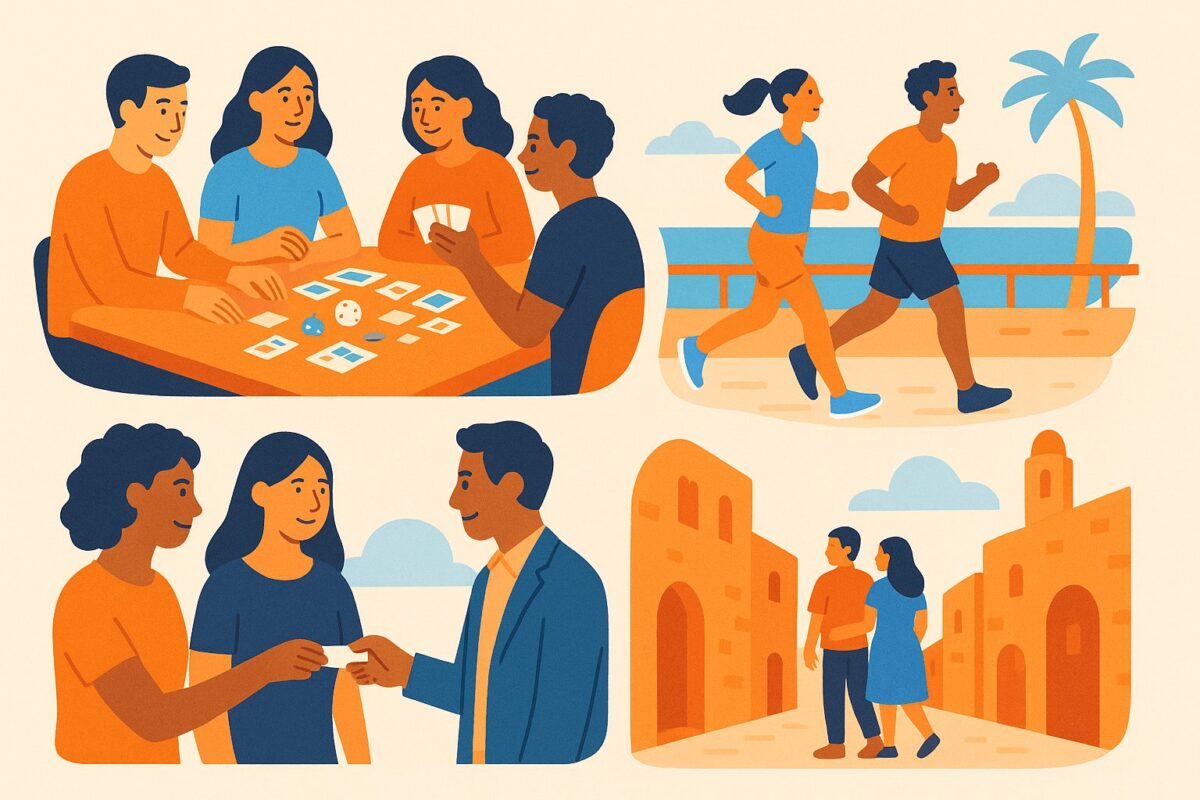
On Tusovka, you can get together over a board game, for a morning run along the sea, or to meet people you might later start something with. The format shapes the pace of the evening, the atmosphere and how deep the conversation goes. If you know in advance what to expect from each one, you don’t have to pick your first meetup at random.
Board games: a gentle start if meeting new people is hard for you
Board games are the most relaxed way to fit into a group. You don’t have to force out small talk: the rules give everyone a reason to talk, argue and laugh. After one evening at the table you’ll know someone better than after an hour of polite chat by the coffee counter.
And you don’t have to play at a friend’s place. A meetup can be held at a cafe, a pay-by-the-hour anticafe or a venue from the business directory: the organizer picks a place from the list or simply drops a pin on the map. The games vary too: light party games for a loud crowd, thoughtful tactical euro games, role-playing campaigns that run over several meetups in a row. If live conversation doesn’t come easily to you, start with board games: the game will do half the work for you.
Running and sports: why is it easier to stay on track together?
A sports community rests on a simple fact: training together is easier than talking yourself into it alone. It’s hard to sleep through a Saturday run with a running community when specific people are waiting for you at a specific spot. Skipping a meetup you agreed to out loud is much harder than hitting snooze on your alarm.
It doesn’t stop at running. The feed has Running, Sports and Hiking categories, and they fit almost anything that’s easier to do together: yoga, cycling, street workouts, swimming, trips out into nature. This format suits people who bond more easily in motion than over a conversation. Here the talking comes on its own, after the workout, over water and stretching, and getting fitter is a pleasant side effect.
What are networking meetups good for?
Networking meetups (in the feed, that’s the Networking and careers category) suit people who want business connections on top of good company. They attract entrepreneurs, freelancers and specialists who moved recently and are building their network from scratch. The format is usually built around short introductions: everyone says what they do and what they’re looking for.
What sets networking apart from a chance encounter is that everyone came for the same reason you did. You don’t have to wonder whether it’s okay to swap contacts: that’s exactly why everyone is there. If you’re new to the country and haven’t built a professional circle yet, this is the fastest way to grow one.
Walks and city routes
Walks (the Walks and tours category) often get overlooked, even though meeting on foot takes a lot of the pressure off. You don’t have to sit across from someone and hold eye contact, the conversation flows by itself, and pauses don’t feel heavy. Along the way you get to know the city: old neighborhoods, markets, waterfront promenades, places you usually drive past without a second look.
For a newcomer, it’s a good first step. After an hour and a half of unhurried walking, strangers stop feeling like strangers. A walk doesn’t commit you to anything, and coming back for the next one is easy.
Conversation and topic communities
This covers everything built around a topic: language meetups to practice Hebrew or English, movie nights, get-togethers for music lovers, conversation just for the sake of it. The feed has Languages, Movies and TV, Music and Socializing categories for them. The topic settles the main question of meeting anyone new, what to talk about: the reason for conversation is part of the format from the start, so awkward silences barely get a chance.
If you’ve only recently moved, a language meetup is especially useful. Practicing Hebrew among friendly people is far less scary than in a line at the bank, mistakes are expected here, and there’s no need to blush over them. People who are on the same path have more patience and nitpick less.
Which meetup format should you try first?
Start from how you find it easiest to get close to people:
- Talking to strangers cold is hard for you - board games or sports, where there’s a shared activity and you don’t have to talk.
- You’re looking for business connections - networking meetups.
- You want a gentle start with no strings attached - a walk or a one-off topic meetup.
- You have a specific interest (a language, movies, music) - a meetup or community on that topic.
What to do next
Open the meetup feed and the community catalog: you can browse both without a card and even without logging in. Filter meetups by city and interests and open one that fits. Its page has a description and a “Going” button, and if it’s full, you’ll see “Join the waitlist” instead: when someone drops out, you move to the list of people going automatically and get an email. No community for your interest yet? Click “Create plan” in the feed: anyone who is 18 or older and has a confirmed email can put together a light plan, which is set for three people by default, you included.
One note on access. Communities on Tusovka are closed: only members can sign up for a community’s meetups, and you join with a member card that has a code in the XXXX-XXXX format. Only the community leader issues cards, in person at a meetup or by mail, and if you don’t have one, click “No card? Ask a community leader” on the community page. Once you have your card, activate it on the activation page and you’re a member of the community. You can join several communities, each with its own card, so there’s little risk in trying a format that turns out not to be yours: you’ll know what suits you after the first meetup or two.